Singleton Shmingleton - Recommission
 Jesse Barker Plotkin
January 13, 2025
Recommission some Unearth-like spells in new ways for maximum value!
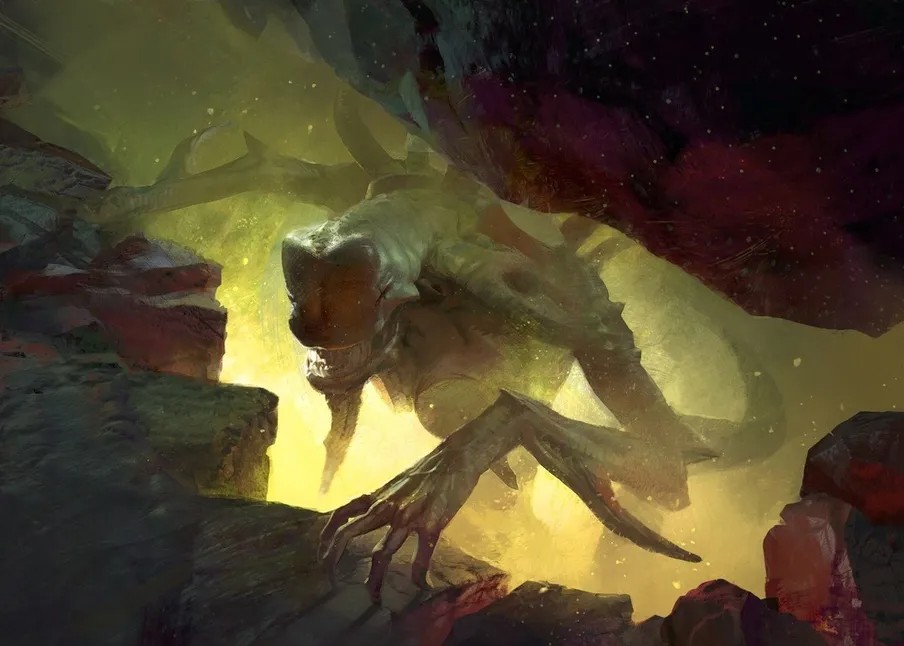
Unearth | art by Jehan Choo
Fun-Sized Reanimates
Hello, and welcome back to Singleton Shmingleton, where I bend the singleton rules of Commander by building decks with as many functional reprints of a certain card as possible.
On the docket today is a card that has been a perennially solid Limited pick for the last few years, while also breaking into Standard in fringe decks.
Recommission is an exciting rate: for two mana, we can return a three drop to the battlefield and even give it a bonus counter. In terms of raw stats, that's incredible; but it does have a real setup cost.
Last winter, we got an even more efficient version of this effect in Helping Hand, and those two cards enabled a spicy Standard deck alongside Monastery Mentor and Geralf, the Fleshwright that tried to play a pure tempo game and never let the opponent regain balance.
But before Recommission and Helping Hand, there was Unearth. Dating all the way back to Urza's Legacy, this card has been the paragon of efficiency of "fair" Reanimate spells, seeing niche play in several formats. And for a long time, it was fairly unique.
White got several cards that cared about returning permanents with cost two or less, from Tethmos High Priest to Renegade Rallier, but Sevinne's Reclamation and Recommission ushered in the era of returning three drops, and this effect has proliferated in both white and black.
There are now fifteen ways to return a three drop from the graveyard to the battlefield for three or fewer mana. Here they are:

The most played of these cards, in 162,007 decks, is Sevinne's Reclamation. This spell is not only a huge amount of flexibility and value from your hand and from the graveyard, it also forms part of any Intuition pile in cEDH alongside Underworld Breach, making it a staple there.
The next most played card is Unearth itself, seeing play in 84,757 decks. It's still an incredible value card, cheap in terms of mana and money, and carries the name recognition of twenty-five years of cool plays. The least played card on this list, by a long shot, is Revoke Demise.
Most of these cards see decent play, in a few thousand decks, but this one is only in 115 decks. It is a common from a Jumpstart set, so many people (myself included) have probably never seen it before, and it can never actually discount a three drop.
At the Three-Point Line
These cards give us an efficient way to put cheap creatures into play, but we want to focus on three drops in specific. Just like in basketball, three is more than two, so we should never take a layup (I totally know how basketball works).
If we can fill our graveyard well enough, then our 'yard can act as a sort of toolbox for our Recommissions to pull from.
So what kind of three-pointers do we want to include? One for every situation, and the best in the game.
First off, we'll want ways to interact. Fiend Hunter and Bone Shredder can act as removal for creatures, Loran of the Third Path can deal with artifacts and enchantments, and Sin Collector can even stop instants and sorceries before they happen.
Bone Shredder's Echo ability may not be pure downside in this deck; having an easy way to return it to the graveyard makes it re-usable!
Any Commander deck needs to pack some ramp and card draw, and this deck is no exception. Claim Jumper can catch us up by two whole lands if someone else is going fast, and Airlift Chaplain can make sure we hit our land drops while filling our graveyard further.
For card draw, all of Welcoming Vampire, Enduring Innocence, and Mentor of the Meek can refill our hand as we continue to run out little utility creatures.
And if we're talking three pointers, there are some veritable Steph Curries that we can't leave on the bench (surely that analogy tracks). Recruiter of the Guard forms the backbone of any toolbox strategy, letting us find the perfect answer to any situation.
White Plume Adventurer broke Legacy and still holds its own in Vintage, and while the Initiative isn't always as insurmountable in multiplayer as in one-on-one, when it is, it's the best thing we can be doing, and so White Plume Adventurer deserves a spot in our toolbox.
And since most of our creatures gain value through enters triggers, Delney, Streetwise Lookout can double up any of our little guy's' effects. There are a couple more cards that aren't of quite the same caliber, but pull their weight in this deck in particular.
Breathless Knight and Patched Plaything both pay us off for bringing them out of the graveyard rather than from our hand, and even in Commander they're impressive beaters.
A Tempting Twist
While I was looking at all of the wonderful three drops we could play, I stumbled across another card that fits this strategy incredibly well. Nazgûl wants us to get as many copies as possible into play, and if we can stock our graveyard well enough, our Recommissions can effectively give us extra copies by making us see a lot of them more often.
The first Nazgûl results in one counter on itself, but the second leads to two on both, and the third leads to three counters on each of three Nazgûl. Exponential growth is nothing to scoff at, so we want to see as many of these Wraiths as we can in order to speed-run the The Ring Tempts You emblem, and grow our army of Nazgûl into a formidable board.
There are a surprising number of ways that Nazgûl fit into the strategy that we've already outlined. Even though they grow, they enter as one-powered creatures, meaning they still synergize with Delney, Streetwise Lookout and our Enduring Innocence-style effects.
We have a ton of small creatures that benefit from becoming ring-bearers, as Skulk is best on small creatures. And the second level of The Ring Tempts You works quite well with our strategy of filling our graveyard and seeing as many cards as possible.
There is one card we just need to run alongside Nazgûl in this deck: Haakon, Stromgald Scourge. All of our Nazgûl are knights, so Haakon, Stromgald Scourge lets us cast them from our graveyard and hold up our Recommissions for other creatures.
Plus, his downside of not being castable except from the graveyard is hardly an obstacle, since we're looking to stock our graveyard, and can even just discard him to a The Ring Tempts You trigger.
Haakon, Stromgald Scourge doesn't show up anywhere on Nazgûl's High Synergy page, and I think people are sleeping on this interaction.
Stocking the Graveyard
The limiting factor on our strategy is our ability to dump our deck into the graveyard so we can pick and choose whatever we need from it. Luckily, in black we've got a ton of powerful options to mill large chunks of cards at a time.
Starting off with three black enchantments, Ripples of Undeath, Cemetery Tampering, and Out of the Tombs all offer tons of mill while also giving advantage.
Ripples of Undeath and Cemetery Tampering give us the chance to get extra cards, and Out of the Tombs turns into a powerful endgame engine if it lasts long enough.
Dredge is always a powerful way to fill up a graveyard, but in this deck, Stinkweed Imp and Golgari Thug are all-stars. If we get to the second level of The Ring Tempts You, then we can Dredge back a creature when our Ring-bearer attacks, and then discard it again, letting us re-use the effect over and over.
Plus, Stinkweed Imp is a respectable target for Recommissions as a Flying blocker that can kill any size of attacker. And we couldn't make a package of creatures that mill without including Stitcher's Supplier, the most efficient one of all.
The Decklist
Unearthly Delights
This is one of the most consistent decks I've played. With nine copies of Nazgûl and fourteen Recommissions, it's going to do its thing every single game. But what surprised me is that, despite the reliability of the core engine, the games play out differently every time.
The rest of our deck is a toolbox of reactive creatures, and so we can pivot easily from offense to defense, and the pace of our game depends on what our opponents are up to.
If you're a fan of the scrappy gameplay of Death and Taxes decks in Modern and Legacy, this deck plays out a lot like that, trying to disrupt our opponents just enough to stop them from outpacing our Nazgûl army.
Until Next Time
The game's very first win condition remains one of the most returned-to designs of all time. There are dozens of riffs on this card, and many have served to cap off big mana combos throughout the game's history.
Commander is the format with the biggest mana of all, so what shenanigans can we get up to with this most fundamental of all wizarding spells?
Read More
Sméagol, Helpful Guide Commander Deck Tech Conditions Allow - Frodo, Sauron's Bane EDH