Singleton Shmingleton - Raise Dead
 Jesse Barker Plotkin
April 21, 2025
Your graveyard becomes your second library with this graveyard-centric strategy utilizing some of Magic's best reanimate spells.
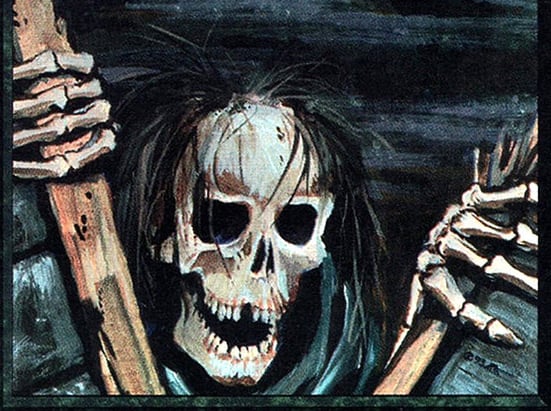
Raise Dead | Art by Jeff A. Menges
Which Entomb? Disentomb!
Welcome back to Singleton Shmingleton, where I bend the singleton rules of Commander by building decks with as many functional reprints of a specific card as possible.
Today's card helped establish black's role in the color pie in the very first set. It's Raise Dead, and, alongside Animate Dead, it broke into the space of letting black cards return creatures from the graveyard.
The design space of reusing cards in the graveyard has come a long way since then, from broken mechanics like dredge and delve to more mundane effects, and I'm willing to bet that there has never been a set without anything that interacts with the graveyard.
But this is where it all started: one mana equals one card, and this design was clean enough that there have been over a dozen riffs on it.
As far as I know, Raise Dead has never seen competitive play, but the design is intriguing. There's a setup cost, sure, but one mana for one card is a pretty good deal.
Ponder is a multi-format all-star for its ability to draw a good card for one mana, and Raise Dead offers a similar rate if you've got a stocked graveyard.
But the reason Ponder is so good is that it's never the wrong time to have it: you can cast it on turn one to try and find a land, or on turn twelve to dig for a spell. Raise Dead likely won't do anything at all until the midgame.
There are fifteen spells that return a creature card from the bin to your hand for one mana. Here they are:

The most played of these cards, in 54,088 decks, is Virtue of Strength, and most players are not including this card for its Adventure mode, though they'll take it if it comes up. Virtue of Strength is an incredible mana-tripler that can get pretty ridiculous in any sort of lands deck, but it'll also do the job for us just fine.
The next most played card, in 30,827 decks, is Sam's Desperate Rescue. I guess for decks that care about being tempted by the Ring, there aren't a whole lot of options, because this card isn't blowing me away compared to the others. The least played card on the list is Return to Battle, in only 272 decks.
It has the exact same effect as Raise Dead, but it's from the little-known Portal: Three Kingdoms set, and it costs about $3, which is more money than I would spend on one of the most replaceable commons in the game.
It was also nice to see that people are putting some respect on the names of Raise Dead and Disentomb. These two "vanilla" versions of this card have each seen tons of reprints and have made their way into 7,738 and 8,247 decks, respectively.
That only puts them at numbers seven and eight on the list, but almost all of the cards they're beating out are strictly better than them. People know what they want.
If they're putting a card like this into their deck, it's not for the raw power, so why not stick to the classics? Sure, you might get an edge off of Ghoulcaller's Chant every once in a while, but little edges aren't what most people look for when building decks.
Raising Dead for Profit
I know a few things about the deck we're going to build already: we need to put a lot of creature cards into the graveyard, and we need those creatures to do a variety of different things.
If Raise Dead can act as card selection, it's a good rate, though obviously still not busted. Lots of blue decks gain consistency from running every card-selection cantrip from Brainstorm to Opt, and this deck can emulate that gameplay.
We want to run a good number of creatures that can act almost as spells by having an effect and putting themselves in the graveyard.
Recurring spells over and over is more powerful than recurring creatures, since the spells send themselves to the graveyard, whereas it takes extra steps to put a creature in the bin.
If they printed a Call to Mind for one mana, it would be broken. The range of pseudo-spells we can run in the form of creatures is smaller, but still wide enough that we can generate some nice value.
Cards with Channel fit the bill perfectly. Colossal Skyturtle gives us two different options, one of which can even recur our Raise Deads for a weird loop, if that's ever what we want. Mirrorshell Crab and Ghost-Lit Warder each act as a returnable Counterspell, and Shinen of Life's Roar is more powerful and flexible than it looks at first.
You can use it when you have a big creature and assign damage to everything your opponents wouldn't have blocked with otherwise, you can use it to make everyone block a little guy and let the big creatures through, and you can even use it on opponents' turns to cause utter mayhem, and once you've done it once and returned it to your hand, it can be a powerful bargaining tool.
Another ability that contains a ton of helpful spell-creatures is Evoke. Mulldrifter acts as a returnable Divination, Shriekmaw acts as Terror, and Subtlety can be its own (very powerful) spell. All of these creatures are already naturally flexible because of their alternate costs, meaning this deck will be well-poised to pivot to a wide range of situations.
Building an Engine
The cards I've listed so far help make this deck very interactive and flexible, but they don't actively build toward a gameplan. In this day and age, Commander games are won far more often off the back of overwhelming value than from slow, incremental advantage.
There is a small but growing group of cards that will reward us just for the act of moving cards between zones. Insidious Roots, Desecrated Tomb, and Skeleton Crew are among the tried and tested, but Tarkir: Dragonstorm introduces a few new cards to the fray.
Kishla Skimmer is a ridiculous draw engine in this deck, and it will be trivially easy to draw a card every turn off of it. Teval's Judgment can give us up to three potent rewards per turn, reminiscent of Monument to Endurance in Discard decks. Kheru Goldkeeper gives us Treasures, and Teval, the Balanced Scale generates 2/2s for days.
These cards all reward us when cards leave the graveyard, which frees us up to spin our wheels in the most unproductive ways possible. I've already mentioned that Colossal Skyturtle and Raise Dead can each return the other for only four mana per loop, but the same can be achieved with Eternal Witness as long as we can find a way to sacrifice it. Even if not, being able to chump block with it every turn is a pretty good deal.
Faerie Macabre is certainly an odd card, but it fits into this deck well. It can put itself in the graveyard for free, and can either give us two leaves-the-graveyard instances or act as graveyard hate in response to someone else's shenanigans.
Life from the Loam and Golgari Thug pull double duty, putting cards into our graveyard to get the party started and also letting us remove those cards. Finally, it wouldn't be a blue graveyard deck without two of the most powerful cards printed in the last twenty years in Treasure Cruise and Dig Through Time.
There are two reasonable options for commanders for this deck. The aforementioned Teval, the Balanced Scale is an exciting new Dragon that fits our gameplan perfectly, but Tormod, the Desecrator does almost as much while coming along with a companion (in this case, Thrasios, Triton Hero for the colors).
I think people should have more decks with multiple commanders they can switch in and out, like precons with their backup commanders, but it's neat that there are now two good options in this neat design niche.
The Decklist
The Disentombed
This deck is super interactive and can fit itself into almost any game state while also showcasing a really cool engine and some rarely seen cards.
The leaves-the-graveyard theme has definitely reached critical mass at this point, and can generate some real value. Insidious Roots is still the most powerful payoff, but Teval's Judgment is also ridiculous.
The Raise Deads still aren't broken, but they never will be, and the deck could not function without them. Other card selection spells, like Brainstorm or tutors, can make each game play out similarly by looking for the most powerful cards, but Raise Dead adds an interesting wrinkle by letting us reuse what we've already found over and over. This deck is perfect for anyone who loves to spin wheels and use the graveyard like a hand.
Until Next Time
One of the foundational white removal spells, this card has been a pillar of countless Limited formats. Two-mana rivals the rate of cards like Doom Blade in a color that isn't supposed to have the best removal, but it comes with several ways to subvert it, an inherent puzzle for the opponent. How will we make a gameplan out of this kind of pedestrian interaction? Find out next time on Singleton Shmingleton!