
Faeries in Commander
BitterblossomBitterblossom | Art by Jesper Ejsing
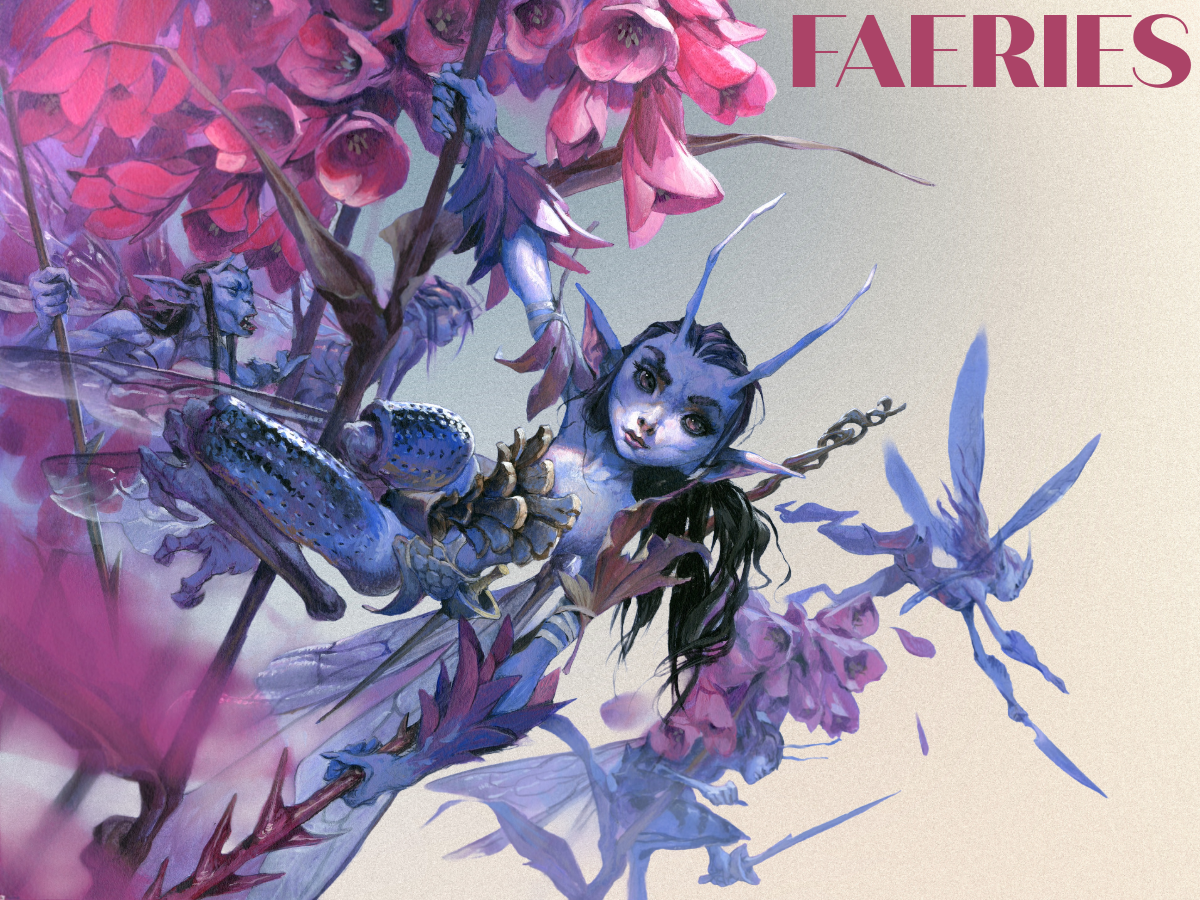
Faeries are tricky creatures, inconsistent in their depictions throughout fiction. Are they small, winged humanoids living amongst flowers, or seductive monsters preying on the foolish? Their mastery of illusion just complicates things further.
So how do Faeries play in Commander? What are the strengths and weaknesses of Faeries in Commander? And how do Faeries win?
This EDHREC Guide is here to answer all of these questions.
What Are Faeries?
Faeries as depicted in Magic regularly fall into the "pixie" or "sprite" archetype, consisting of small winged humanoids with a penchant for trickery. There are deviations of this across the planes, but broadly Faeries all adhere to this across colors.
While primarily , they show up in every color in strength outside of . However, the very first Faerie was the Scryb SpritesScryb Sprites released in Alpha.
Faeries nearly universally have flying as a keyword and low stats. Faeries function as utility and support creatures dependent on what color they are aligned with, such as granting card draw for yourself in or forcing opponents to discard cards in .
Ouphes are a distinct but related creature type depicting fae that look distinct from small humanoids with wings. Due to this similar overlap, certain creatures that would reasonably fall under Faerie are ascribed to the Ouphe creature type instead. Brownies, a type of fae, once had their own creature type that has since been rendered obsolete and merged into Ouphes. This is despite the fact Shelkin BrownieShelkin Brownie was initially a Faerie.
Pros and Cons of Playing Faeries in Commander
Direct Damage
Faeries excel at granting you benefits from dealing combat damage to opponents, sometimes multiple times per turn. This is facilitated by the fact they most commonly have the flying keyword, allowing them to bypass the vast majority of defenders.
What actual benefits you get from dealing direct damage is variable, oftentimes granting you card draw. Some instead force opponents to lose additional life or discard cards. And even though these abilities are incremental, they can trigger regularly and add up quite quickly.
Out-Of-Turn Synergies
Faeries have a number of ways to influence your opponents' game plans even outside of your turn. A fair few Faeries gain flash and therefore can be played even during your opponents' turns. Some instants are tied to Faeries and strengthen off of having more of them. There are even Faeries whose entire utility comes from you gaining benefits off of triggers happening in other players' turns.
These are all different ways to allow for Faeries to be extremely active at any turn of the round, so long as they have any amount of mana left. And due to how cheap Faeries and their spells are, that doesn't need to be much.
Bouncing Effects
Faeries benefit from entering the battlefield (ETB), being cast, or even dying. This means that the ability to return them to your hand via a bounce effect or a keyword such as ninjitsu allows for you to gain the same ETB multiple times over. Particularly due to their synergy with Rogues, Ninjas find quite a bit of overlap with Faeries.
They tend to be quite cheap, meaning any ability to consistently or repeatedly return Faeries to your hand gives incredible value. Each individual Faeries' main utility often comes from being another Faerie on the board, rather than having a specific statline or ability, further adding to the interchangeability of most of your creatures.
They're a Lot
Faeries take a lot of finesse to properly pilot. Not just in the same way any deck requires a competent player, but they have a lot of upkeep to keep track of: Faerie ETBs, out-of-turn triggers from your creatures, direct combat damage triggers, copying spells, and any other strategies you have implemented as well.
A Faerie deck needs you to be on top of things; the timing of when to cast a creature with flash or when to pop a spell that bounces a Faerie back to your hand are decisions you'll have to keep making. The key is to have tunnel vision on one specific strategy and not get attached to any particular Faerie, given how easy it is for you to rotate out your battlefield.
No One Strength
Faeries don't have much support to make a singular strong creature. Or even to get multiple creatures to a reasonable level. Faeries tend to have low power and toughness, and in-type support to increase those are uncommon. It's present, but not in the same way Elves or Cats might find it.
Instead, Faeries rely on getting to a mid-range statline that with flying can bypass defenders. They aren't trying to overcome opponents' blockers, they're trying to avoid them. Therefore, you don't need to worry about getting your creatures to high statlines outside of blocking. And unless an opponent has trample, that's what tokens are for.
The Best Faerie Commanders
Alela, Cunning ConquerorAlela, Cunning Conqueror
Alela, Cunning ConquerorAlela, Cunning Conqueror is a 2/4 with flying. Whenever you cast your first spell during each opponent's turn, you create a 1/1 Faerie Rogue with flying. When one or more Faeries deal combat damage to a player, goad a creature that player controls. Goad forces a creature to attack each combat if able and to attack a player other than you.
This means that so long as you can cast instants or any Faeries with flash, you can build up a wide array of tokens. Given they have flying, they can likely attack an opponent directly meaning you're able to goad a creature they control. This can range from annoying harassment to complete disruption of their strategies, depending on what creatures they have available for you to goad and how other opponents can respond. Alela forces the board to remain violent, allowing you to ride the wave of chaos.
Alela, Artful ProvocateurAlela, Artful Provocateur
Alela, Artful ProvocateurAlela, Artful Provocateur is a 2/3 with flying, deathtouch, and lifelink. It grants other creatures with flying +1/+0 and creates a 1/1 Faerie with flying whenever you cast an artifact or enchantment.
At its base, Alela being a 2/3 with flying and deathtouch makes it quite the unappealing attacker to block, opening up a great way to get consistent chip damage against opponents. Lifelink with these constant attacks will give you some nice sustainability, while the ability to create 2/1 flying Faeries gives good blockers. Your biggest bottleneck will be your ability to play artifacts and enchantments, but mana-generating or cost-reducing artifacts will allow you to chain spells and build up a sizable force.
Maralen, Fae AscendantMaralen, Fae Ascendant
Maralen, Fae AscendantMaralen, Fae Ascendant is a 4/5 with flying who has an ETB that exiles the top two cards of an opponent's library. Maralen grants this same ETB effect to your other Elf and Faerie creatures. You may then cast a spell from those exiled with Maralen this turn with mana value less than or equal to your number of Elves and Faeries.
Maralen benefits from having many small creatures on the board, which both Elves and Faeries excel at, but that hits diminishing returns fairly quickly. Maralen can only cast spells exiled with Maralen that same turn and only once per turn. Once you have a floor of Elves and Faeries to overcome the cost of most spell, you don't actually benefit from spamming out more in a turn. Instead, stagger them over multiple turns to maximize the amount of spells you can cast from exile.
Tegwyll, Duke of SplendorTegwyll, Duke of Splendor
Tegwyll, Duke of SplendorTegwyll, Duke of Splendor is a 2/3 with flying and deathtouch who grants your other Faeries +1+1. Whenever one of your Faeries dies, you draw a card and lose one life.
Tegwyll thrives off of sacrificing your own Faeries to generate fantastic card draw. With how populous Faeries are, you'll need to make sure you can sustain your life total, but for the majority of the game you should be generating Faerie tokens and then sacrificing them for other benefits. Tegwyll enhances your engine by giving you card draw, where you're looking for active engagement spells to target your opponents directly. This might be direct damage, targeted removal, or disruption such as forced discard or mill.
Obyra, Dreaming DuelistObyra, Dreaming Duelist
Obyra, Dreaming DuelistObyra, Dreaming Duelist is a 2/2 with flash and flying which grants your other Faeries an ETB to cause each opponent to lose one life.
Faeries excel at arriving unexpectedly, so while Obyra has the ability to whittle away at opponents over time, that's not actually its greatest strength. Obyra can be cast for cheap using flash, followed by a cascade of Faerie generation. This can be out of your turn, such as during the end step of the opponent going right before you to ensure you can start your turn with fully untapped lands to cast more spells. Or it could be entirely operated on another player's turn, dealing multiple pings of damage to each opponent when no one is prepared for it. This is most effective as a way to take out an opponent that's already low.
Talion, the Kindly LordTalion, the Kindly Lord
Talion, the Kindly LordTalion, the Kindly Lord is a 3/4 with flying who has an ETB where you choose a number between one and ten. Whenever an opponent casts a spell with mana value, power, or toughness equal to the chosen number, that player loses two life and you draw a card.
This is an extremely tricky card, given its value increases the better you know your opponents' decks. In the early game you can aggressively choose "one" and force any utility creatures and mana-produces to come with a tax. You can choose "two" to target counterspells or "three" for lots of removal. Alternatively, you could go a larger number like "six" or "seven" that's a reasonable power or toughness for mid-game creatures. You can even target the power or toughness of a commander you want to keep off the board.
Two life and you drawing a card won't deter most opponents from casting a spell they want to, but it'll certainly add up if you choose the right number.
Oona, Queen of the FaeOona, Queen of the Fae
Oona, Queen of the FaeOona, Queen of the Fae is a 5/5 with flying. You can choose a color, then pay to exile the top X cards from an opponent's library. For each card of the chosen color exiled, create a 1/1 Faerie Rogue with flying.
This is somewhat expensive mill, with the addition of it exiling cards as opposed to just discarding them. But of course, the value here come from creating Faerie tokens based on colors being exiled. This won't be a 1:1 generation per mana spent even in a monocolored deck, both due to that in the activation cost but also due to lands, artifacts, and other colorless cards. But it's a fun, forward-facing way of both interacting with an opponent and generating more Faeries.
Ivy, Gleeful SpellthiefIvy, Gleeful Spellthief
Ivy, Gleeful SpellthiefIvy, Gleeful Spellthief is a 2/1 with flying who allows you to copy any spell that targets only a single creature other than it, with the copy targeting Ivy.
Ivy specifies anytime a player casts a spell, not an opponent, so as long as you include buffing spells you'll be able to double your value. Atop this, you can build up quite the heavy hitter with only a single round passing, depending on what decks your opponents are running. Quite a few spells you can copy won't necessarily do much for you, given many only last until the end of the turn. But the odd +1/+1 counter here or a shield counter there will add up and turn Ivy into a formidable creature.
Staples for Faerie Commander Decks
Maraleaf PixieMaraleaf Pixie
Maraleaf PixieMaraleaf Pixie is a 2/2 with flying that can tap for or .
Maraleaf Pixie is actually twice as expensive as many other mana-producing creatures, but also twice as powerful with flying. Its main utility comes from the fact is can grant mana of two different colors and that it's a Faerie. It will help with mana production and is cheap enough to justify, even if it won't be replacing any staple mana-producer.
Nymris, Oona's TricksterNymris, Oona's Trickster
Nymris, Oona's TricksterNymris, Oona's Trickster is a 1/6 with flying and flash. Whenever you cast your first spell each opponents' turn, look at the top two cards of your library and put one in your hand and the other in the graveyard.
This both gives you card draw and thins your deck. While it isn't ideal for Faeries to be throwing cards in the graveyard, you get to choose what to send there and you aren't hurting for graveyard reclamation in . Nymris can trigger its own ETB, allowing you to get the ball rolling immediately while also setting yourself up with a decent blocker.
Shadow PuppeteersShadow Puppeteers
Shadow PuppeteersShadow Puppeteers is a 4/4 with flying, ward , and an ETB to create two 1/1 Faerie Rogues with flying. Whenever a creature you control with flying attacks, you can have it become a 4/4 Dragon until end of turn.
This converts all of your Faeries into Dragons when they attack, but with a few notes to keep track of. They become a red Dragon in addition to their other colors and types, meaning you still have a board of Faeries. They have a base power and toughness of 4/4, meaning they still get bonuses from other Faeries. These mean that Shadow Puppeteers can not just turn a series of 1/1 Faeries into 4/4 Dragons, but effectively gives them +3/+3 onto whatever other bonuses they already had, such as from Alela, Artful ProvocateurAlela, Artful Provocateur or Tegwyll, Duke of SplendorTegwyll, Duke of Splendor.
SkullclampSkullclamp
SkullclampSkullclamp grants a creature +1/-1 and has you draw two cards when they die.
Faeries usually have a toughness of one and a fair few have effects that trigger on their death. This means you can equip Skullclamp to a series of low-toughness Faeries that give you benefits and draw even more cards atop what they would normally give you. It's quick, it's cheap, and it gets your hand full.
Bident of ThassaBident of Thassa
Bident of ThassaBident of Thassa lets you draw a card each time a creature you control deals combat damage to a player, which for Faeries that are incredibly numerous and all have flying is quite often. It can also tap for to force creatures your opponents control to attack this turn if able.
Card draw on direct damage is the main draw here, though being able to force your opponent to attack is pretty in-line with the tricks of the fae! You have to watch out that they don't direct all of that aggression on you, but even still you'll have enough blockers that you should be fine. The main reason for this is to open up their defensive line so you can attack them directly, particularly if they have blockers capable of defending against flyers.
Vedalken OrreryVedalken Orrery
Vedalken OrreryVedalken Orrery allows you to cast spells as though they had flash, allowing you to cast them any time you could an instant.
This is most useful for when you have a creature such as Nymris, Oona's TricksterNymris, Oona's Trickster which grants you benefits off of playing cards on your opponents' turn. The Orrey gives you greater flexibility in what you can play and opens up any of your Faeries without flash to join in on the fun. It's the sort of facilitation piece that smooths out your ability to engage with the game.
Kindred DiscoveryKindred Discovery
Kindred DiscoveryKindred Discovery enters with you choosing a creature type. Anytime those creatures ETB or attack, you draw a card.
This is a fairly expensive card, particularly when compared to your Faeries. So it's going to see its most use in the mid-late game, which is when you'll have enough Faeries to make it worth it the first turn you play it. Your largest concern will be drawing too many cards, given how easily you can both create and attack with Faeries.
BitterblossomBitterblossom
BitterblossomBitterblossom causes you to lose 1 life and create a 1/1 Faeries Rogue with flying at the beginning of your upkeep.
This gives consistent value from any Faerie ETB triggers you have alongside increase your total number of Faeries for cheap. This is such a low-cost life drain over time that it shouldn't dissuade you from casting Bitterblossom even if you're low. Faeries have the agility to rapidly explode if left unchecked, so this is almost always a good decision to help propagate them further.
Reflections of LittjaraReflections of Littjara
Reflections of LittjaraReflections of Littjara enters with you choosing a creature type. Whenever you cast a spell of that type, copy it. This creates a token of whatever creature you were casting.
This doubles your production of cast Faeries, though it doesn't work on token generation or legendary creatures. That said, there are numerous Faeries that have useful ETB or death triggers, which this doubles. Faeries benefit from a volume of creatures that aren't required to stick around very long and this just enhances that. The fact it doesn't include tokens or legendary creatures isn't a significant detraction from its value when playing Faeries.
Notorious ThrongNotorious Throng
Notorious ThrongNotorious Throng creates X 1/1 Faerie Rogues with flying, where X is the amount of damage dealt to your opponents this turn. However, it also has a prowl cost, which can only be paid if you dealt damage to a player this turn with a Rogue. If you pay the prowl cost, you then take an extra turn after this one.
This is a big, explosive sorcery that allows you to balloon out the size of your board. If you have any amount of presence prior to casting it, you can swing across the board at any of your opponents with a series of flying creatures. Any amount of power increases will increase the amount of Faeries created with this spell. Then, if you pay the prowl cost due to having dealt damage with a Faerie Rogue, you can take another turn with your next fleet of Faeries.
Tegwyll's ScouringTegwyll's Scouring
Tegwyll's ScouringTegwyll's Scouring may be cast as if it had flash by tapping three untapped creatures you control with flying in addition to its other costs. It destroys all creatures and creates three 1/1 Faerie Rogues with flying.
This is a board wipe that then recovers some presence for you by giving a trio of Faeries. Not only does this give you blockers, but it sets you up to get back to a state where you have many Faeries to activate your various abilities. The greatest value you'll get from this is casting it with flash, which with how many Faeries you have shouldn't be an issue. The main cost will be ensuring you have the mana available and that it doesn't get countered by whoever's turn it is.
Faerie FencingFaerie Fencing
Faerie FencingFaerie Fencing costs and grants a creature -X/-X until end of turn. It gets an additional -3/-3 if you control a Faerie.
This ends up being a -4/-4 for , which can take out a good number of creatures. Anything past that is only a little bit more mana, meaning this can remove anything mid-range and below for incredibly cheap. While it can be used to destroy high-toughness creatures or reduce their power during combat, there are other ways more efficient to accomplish that.
Oko, Lorwyn LiegeOko, Lorwyn Liege
Oko, Lorwyn LiegeOko, Lorwyn Liege is a two-sided planeswalker that you can pay mana during your first main phase to transform. It begins with three loyalty counters as Oko, Lorwyn Liege:
+2. Up to one target creature gains all creature types. Should you have any non-Faerie support pieces or utility creatures, this allows you to have a Faerie on the board that won't go anywhere.
+1. Target creature gets -2/-0 until your next turn. A defensive option to reduce the threat of an opponent's creature while still advancing loyalty.
As Oko, Shadowmoor Scion:
-1. Mill three cards and you may put a permanent among them in your hand. This lets you work through your deck for permanents that you want, be they Faeries or enchantments or lands.
-3. Create two 3/3 Elk tokens. With how often you'll be cycling through your low-power, low-toughness Faeries, having a few creatures that are just middling stats to act as blockers isn't bad at all. As Lorwyn Liege, Oko can even make them Faeries.
-6. Choose a creature type and get an emblem with "creatures of the chosen type get +3/+3 and have vigilance and hexproof." This is the main reason to take Oko, since it makes your standard Faerie token a 4/4 with flying, vigilance, and hexproof before any other bonuses. This lets you continue your aggression without any real fear of reprisal, unless an opponent has significant flyers or reach blockers of their own.
Faerie ConclaveFaerie Conclave
Faerie ConclaveFaerie Conclave can tap for or you can spend to have it become a 2/1 Faerie with flying until the end of turn.
This allows you create one more Faerie upon demand, with a 2/1 statline exceeding that of most tokens. It won't change the course of a game in all liklihood, but it's a useful trick to whip out when you're looking to make a move dependent on how many Faeries you have.
How To Win With Faeries in Commander
Faeries have a number of ways of generating tokens, bypassing defenders, and gaining benefits from direct combat damage. What they don't have is many ways to deal massive damage in a single swing.
Instead, they rely on consistent pressure that reduces the life total an opponent bit by bit until you can surge forth a swarm of Faeries that can close the job. What threshhold your ability to rush them down begins at is dependent on how much you invest in strengthening your creatures. You have the ability to focus on many stacking bonuses to power, sacrificing quantity for quality.
Or you could prioritize getting out more Faeries, each of whom would only get a few bonuses to their power. All of whom would be primed to attack enemies directly for additional effects each hit.
Due to how cheap they are, Faeries are very convenient to use as fodder for ninjitsu or sneak. This is doubled in their ETBs which are then able to activate multiple times. On top of that, many Faeries and most Faerie tokens are Faerie Rogues, which synergize with Ninjas and similar creature types.
Therefore, Faeries can support another creature type archetype to set them up for heavier swings against an opponent. These Faeries act as keys to cast, attack, then return to your hand and bring forth other creatures. This could be a combo like Dark Leo & ShredderDark Leo & Shredder and Wound ReflectionWound Reflection or just a powerful creature like Taeko, the Patient AvalancheTaeko, the Patient Avalanche.