Top 10 Multi-Colored Cycles
 DougY
January 17, 2025
Elder Dragons and multicolor cycles are the star of this top 10 EDH list!
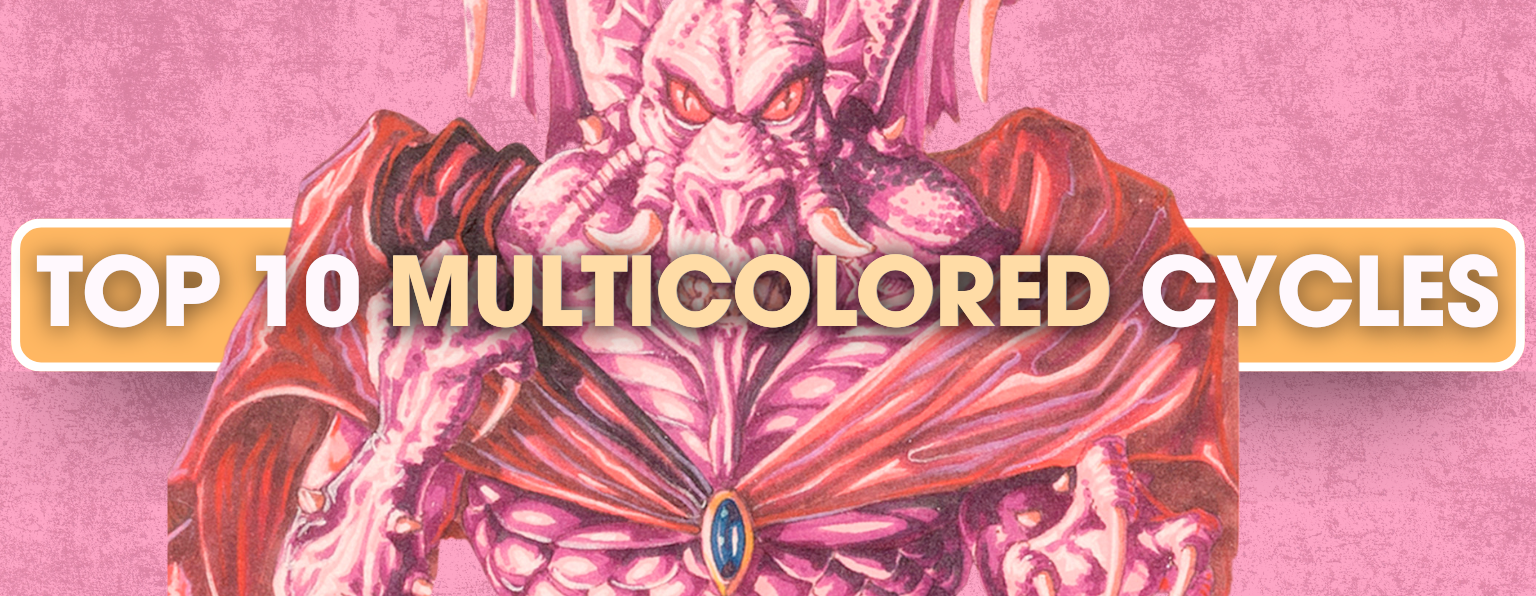
(Arcades Sabboth | Art by Edward Beard, Jr.)
It's Like Poetry, You See...
Welcome to Too-Specific Top 10, where if there isn’t a category to rank our pet card at the top of, we’ll just make one up! (Did you know that the original Elder Dragon cycle is the only cycle that features only eight-mana cards?)
Throughout Magic's history, there have been delightful little trails of M&M's for us to follow as we look through sets, lovingly left there by the designers for us to find and enjoy.
Those trails are more commonly known as cycles, and they are one of my favorite things about this hobby of ours.
Even starting in Limited Edition Alpha, you could tell that Richard Garfield loved the idea of having a set of similar cards across colors, from the most famous example of the Boons--a series of one-mana instants revolving around the number three--to the building blocks of the game: Basic lands.
Alpha also had every collectors' least favorite cycle, the Laces, along with attempting the five Circles of Protection (printing issues rather famously ended up leaving out Circle of Protection: Black).
That love of symmetry and themes has stuck with the game for more than 30 years, but the one that first captured my imagination and created the format we all know and love? That was the first multi-colored cycle, the Elder Dragons.
Top 10 Multi-Colored Cycles
Okay, okay, there were actually lots of multi-colored cycles that came out simultaneously in Legends. If you asked most folks today, however, they would be a lot less likely to remember Jasmine Boreal and Nebuchadnezzar than they would be Nicol Bolas and Arcades Sabboth.
Why? Because they were the original attempt at the quintessential Timmy/Tammy cards: "What's better than a Dragon? Why, an ancient huge Dragon, of course!"
The Elder Dragons spawned Commander for a reason: They were notorious, from the day they were printed, and they were huge, unwieldy things that never stood a chance to see the field in competitive Magic of any kind.
This is precisely what led Sheldon Menery and his Air Force friends, followed by his judge friends, to create a format intentionally slow enough and with high enough variance that you could imagine yourself not just swinging in with a Palladia-Mors, but doing it three times in succession to kill with commander damage.
That dream is once again gone these days, and most aren't looking for the three-hour games that were necessary for it to be viable anymore, anyhow. I for one, however, still remember the early days of Magic when you would hear stories of Nicol Bolas on the playground and not believe them.
A huge, eight-mana Dragon that made everyone discard their hand? Yeah, and your uncle works at Nintendo. Sure, Jerry.
Those playground stories and early internet legends are also what spawned a love of cycles in Magic, and I believe are one of the main reasons that the trend has had such staying power.
Designers also remember hearing about these "Elder Dragons" and not believing the sheer mass and absurdity of them, and wanted to make cards that had the same amount of splash.
Cards that would be talked about in the LGS and the playground alike, that would be remembered, and above all, identifiable.
So, why don't we see how they did?
Criteria: Multicolored cards in batches of five or more that have similar design qualities across the same set, or similar names and design across the history of Magic, and an easily determinable theme in common. As is tradition, all results are ordered by EDHREC score, only in this case, we will average the inclusions of the entire cycle.

10. Strixhaven Elder Dragons: Beledros Witherbloom, Shadrix Silverquill, Galazeth Prismari, Velomachus Lorehold, & Tanazir Quandrix
(Average Inclusions: 19,807)
Fittingly enough, our number ten slot is an homage to the original Elder Dragons, only a little less unwieldy this time. In fact, despite nearly 20 years of not wanting to mess with the sacred "Elder" typing, Elder Dragons have now ballooned up to 27 entries total, with the larger Elder typing having 43 entries as of today's writing.
The most popular of them all? The Elder Dinosaurs, out of original Ixalan. The most popular multi-color cycle of Elder Dragons, however? That's the Strixhaven Elder Dragons, the spiritual inspiration for each of the two-color Strixhaven colleges.
Of these, there is one entry bringing up the average more than just a bit. Beledros Witherbloom is sporting 43,000 decks, which is no surprise when you read his "untap all lands" ability.
Don't get me wrong, making four Pests a turn cycle is also quite good, but there's a reason that so many decks are sporting Beledros, and it's not blockers with incidental lifegain.
As for the rest of them? Shadrix Silverquill is a quite well-regarded political commander/inclusion, Galazeth Prismari is an extremely fun puzzle of an artifact and spellslinger commander to solve, and as usual, the Boros entry was priced so high that no one plays it, despite it being an amazing effect not seen anywhere else in the color combination.
As for Tanazir Quandrix, it's a fine +1/+1 counter commander in a color combination filled to the brim with much of the same, and has just gotten lost in the shuffle.

9. Modern Horizons 3 Hybrid DFCs: Revitalizing Repast, Stump Stomp, Legion Leadership, Waterlogged Teachings, Strength of the Harvest, Bloodsoaked Insight, Glasswing Grace, Drowner of Truth, Rush of Inspiration, & Suppression Ray
(Average Inclusions: 19,885)
While they're starting to feel a bit old hat now, "Modal Dual-Facing Cards" that allow you to choose whether to play the front or back of a card have only been around for three and a half years, and started with the original cycles of back-facing lands from Zendikar Rising.
This was also the advent of the Pathway lands, but as of this year, Zendikar no longer has the monopoly on land MDFCs. Modern Horizons 3 brought us not only a new cycle of Bolt lands, but also a full cycle of dual-colored hybrid spell-lands.
Not even the top of the list will blow you away, doing simple things like giving a creature a +1/+1 counter and indestructible until end of turn, biting another creature, or searching for an instant for four mana.
The best ability is availability, however, and MDFC lands provide that in spades. Allowing you to take up a land slot with a card that can be played as a land or a spell, so long as you don't go too crazy, the MDFC lands are a "free" slot in the deck, meaning you'll take their meager additions any day of the week.
While that's easier to do with the mono-color versions, these two-color entries have their place in many a deck, as evidenced by them making the number nine slot on our list.

8. Fate Reforged Dragons: Atarka, World Render, Silumgar, the Drifting Death, Kolaghan, the Storm's Fury, Ojutai, Soul of Winter, & Dromoka, the Eternal
(Average Inclusions: 24,347)
Surprisingly, it is the simple "Dragon" versions of the five Dragons from Tarkir that are most played, rather than their Dragons of Tarkir Dragonlord versions that achieved Elder Dragon status in the very next set.
Why the sudden change in status? Well, the Khans of Tarkir block is a time travel story, meaning that we originally visit a world with no Dragons.
This makes Sarkhan sad, so he finds a way to travel back in time to when the Dragons were still around, giving us the events of Fate Reforged.
Then saving the Dragons, he changes the past, resulting in the Dragons for each color combination living to be ancient Dragonlords by the time we go back to the future in Dragons of Tarkir.
Man, remember when we actually had time to tell cool stories about a plane, rather than dipping in for five minutes to see what hats everyone was wearing? Good times.
As for our notably non-Elder Dragons specifically, they all have one thing in common: An emphasis on combat.
Atarka gives out double strike, Silumgar makes blockers smaller (or dead), Kolaghan goes wide with +1/+0 for everyone, Ojutai stuns blockers, and Dromoka gives your smallest creature two +1/+1 counters every turn.
While their Dragonlord versions have a bit more nuance, it turns out that a lot of folks are just looking for straight violence when it comes to their huge Dragons, and these Fate Reforged versions are happy to provide.

7. Ascendancies: Temur Ascendancy, Simic Ascendancy, Brokers Ascendancy, Jeskai Ascendancy, Riveteers Ascendancy, Mardu Ascendancy, Sultai Ascendancy, Abzan Ascendancy, Cabaretti Ascendancy, Maestros Ascendancy, & Obscura Ascendancy
(Average Inclusions: 25,212)
Speaking of Tarkir, the original Ascendancy cycle appeared in Khans of Tarkir, the first set of the block that was defined by its three-color clans which arose from the ashes of the Dragons.
They were each enchantments that emblazoned the intent and flavor of each clan, and even the ones that were bad were a hit with players intellectually, if not actually making their decklists.
This meant that when we did our next three-color set in Streets of New Capenna, the idea of a defining Ascendancy for each gang was right there for designers to revisit, and they did gleefully.
We also got one for specifically only the Simic on Ravnica, which is a beloved alternate win condition, but feels a bit weird as the portion of the cycle that doesn't actually currently fit in with the rest of the cycle.
I'm sure that will change as we continue to revisit Ravnica, but for now, Simic Ascendancy stands alone.
As for which of the Ascendancies people not only like, but actually use? Temur Ascendancy gives all your creatures haste and draws you cards, which is two things that pretty much every deck appreciates.
Brokers Ascendancy is a huge hit with counter decks of all types, with a heaping helping of help for planeswalker decks, as well.
My favorite of the bunch, Jeskai Ascendancy, both makes your creatures huge and also untaps them for shenanigans, and then tacks on some looting for good measure.
The rest come in below our average, although I like Riveteers Ascendancy enough to note that if you're a fan of moving creatures from one pile to another, you need to grab a copy and pump those numbers up.

6. Ultimatums: Ruinous Ultimatum, Eerie Ultimatum, Genesis Ultimatum, Cruel Ultimatum, Titanic Ultimatum, Emergent Ultimatum, Inspired Ultimatum, Brilliant Ultimatum, Violent Ultimatum, Clarion Ultimatum
(Average Inclusions: 26,112)
Back in 2008, a seven-mana spell made up of entirely pips made a splash in Shards of Alara standard. That spell was Cruel Ultimatum, and its continued to rear its ugly head periodically throughout Magic ever since.
This remains true for even the multiplayer format of Commander, where Cruel Ultimatum feels a bit personal, only targeting one player.
Still, removal, discarding most of a player's hand, and losing five life is relevant, even if what you're really looking to do is all that in reverse for yourself.
In any case, Cruel Ultimatum and its lesser played companions out of Shards of Alara were memorable enough that Wizards decided to revisit them in a big way 12 years later, in Ikoria: Lair of the Behemoths.
These more-tuned-for-multiplayer versions are the ones that you're more likely to see at your average commander table these days, and none more so than Ruinous Ultimatum.
The very definition of "one-sided board wipe", Ruinous Ultimatum brings Anakin Skywalker to mind in its thoroughness.

With that said, one playable ultimatum wouldn't have this cycle as high as it is. As I previously said, Cruel Ultimatum still sees a fair amount of play (18,948 inclusions), and there are still two more Ikorian ultimatums before we get to the classics.
Eerie Ultimatum returns all your permanents to the battlefield, for instance, which is nothing to sneer at, especially when you're in the best board wipe colors. Which brings us to Genesis Ultimatum, which does something similar from the top of your deck.
I've never been much of a fan of this one, as it's fairly easy to whiff on, what with only looking at the top five cards of your deck and only hitting permanents.
Still, if you are playing a bunch of massive permanents, it's a roll of the dice that could absolutely pay off.
As for the ultimatums bringing down the average, there are a few that have never really seen play anywhere, but there are also some that I firmly believe should be seeing more play.
After Cruel Ultimatum is what used to be a Naya staple, Titanic Ultimatum.
It's expensive for an Overrun, but the lifelink that is tacked on can really make a difference if you find yourself casting it before it actually wins you the game. After that is Emergent Ultimatum, which is a sort of a mixture of Intuition and Tooth and Nail.
It can obviously go get any number of combos that finish the game no matter what your opponent chooses, but honestly I'm surprised it's not used more for it's Timmy/Tammy version of events where you just go find three huge spells and let an opponent choose which is the worst for them.
Finally, y'all are sleeping on Inspired Ultimatum. I know, I know, all of these ultimatums are hard to cast and a seven-mana spell should more or less win you the game.
Well, I would submit that removing the biggest problem on the table (so long as it's not too big) and drawing five cards should pretty much win you the game, to say nothing of what this thing can do if you make multiple copies of it, as Jeskai is wont to do.
Give it a shot, folks. After all, whoever regretted creating a big, splashy moment?

5. March of the Machine Two-Color Rare Pairs: Ghalta and Mavren, Drana and Linvala, Kogla and Yidaro, Inga and Esika, Yargle and Multani, Djeru and Hazoret, Baral and Kari Zev, Hidetsugu and Kairi, Rankle and Torbran, & Errant and Giada
(Average Inclusions: 30,330)
In addition to these team-ups, there were actually a lot more snuck in at three-color in Thalia and The Gitrog Monster, Shalai and Hallar, Elenda and Azor, Slimefoot and Squee, Rashmi and Ragavan, Zimone and Dina, Zurgo and Ojutai, Goro-Goro and Satoru, Saint Traft and Rem Karolus, Kroxa and Kunoros, Katilda and Lier, and Borborygmos and Fblthp, but they're split between mythic and the commander precons, and have multiple representations per different color pairings.
All in all, the cleaner, more well-represented cycle is the rare two-color cycle, and it's also the more played of the two.
As for what this cycle is? March of the Machine brought forth an interplanar invasion that spread across the entire known multiverse up to that point in Magic story (although the Phyrexians seem to have skipped out on the planes that the story hadn't visited yet. Strange.).
This caused heroes from throughout the multiverse that had previously been enemies to band together against the Phyrexian menace, resulting in a fun snapshot of villains and heroes getting along, if only until the oil settled.
As for the cards themselves? Ghalta and Mavren comes out on top due to the inclusion of the word "Dinosaur" in it type box, being a 12/12 you can sneak into play with multiple Dino commanders that then immediately makes either more Dinosaurs, or a horde of lifelinking Vampires if you're in need of a pick-me-up.
After that, high-powered play bought into Drana and Linvala, as they can both be a Cursed Totem for your opponents and also be a flying vigilant threat that can also tap for mana after combat, or if you're very lucky, provide a creature combo.
Kogla and Yidaro are either an overpriced Disenchant that can't be countered via most Counterspells, or are a six-mana threat that can choose to swing in immediately or remove a creature problem across the table.
Inga and Esika can provide both ramp and card draw, which if you boil things down, those would be the two things that led to most Commander wins.
And then Yargle and Multani round out the list of cards see play above the average, both because they're a meme taken to the next level, and because honestly, there are a lot of cards that can do ridiculous things with an 18 power creature.
As for the rest, for the most part there's a reason they aren't seeing as much play. I did at one point think that Hidetsugu and Kairi were worth playing around with, and had a good time building them.
As the top commenter on that article, ToxicAtomKai, said, however, they are just Yuriko with extra steps.
In similar fashion, the Jenny/Johnny part of my brain wants to make Baral and Kari Zev work, but with the amount of restrictions on the card it's not surprising that not many folks have succeeded in doing so.
I do also want to experiment with a hatebears version of Errant and Giada, but like all high-powered-but-not-cEDH decks, I'm afraid I'd never find anywhere to play it.
Regardless, there are some interesting cards at the bottom of this cycle that may not stay there forever.

4. Omnaths: Omnath, Locus of Rage, Omnath, Locus of Mana, Omnath, Locus of Creation, Omnath, Locus of All, & Omnath, Locus of the Roil
(Average Inclusions: 30,670)
If there was one united call across EDH for the last decade, it was to finish the Omnath cycle. Well, they finally did, and fans held up their end of the bargain, making 13,462 Omnath decks and counting.
And they're not just generic piles of five-color good stuff, either, if you look. All five Omnaths are featured prominently on Locus of All's EDHREC page. As for how well they all play together?
Pretty darn well, all things considered. Omnath, Locus of the Roil went off in an Elemental direction that seems a bit strange, but does pair well with Omnath, Locus of Rage at least, along with the other Omnaths themselves being Elementals.
Omnath, Locus of All triggers off of every Omnath but Omnath, Locus of Mana, putting them into your hand and giving you three mana to get around to casting them.
As for the rest, they're all famous Lands deck commanders, and for good reason.
Put them all in one place, and you have an Elemental swing on a five-color lands deck, and it turns out there are plenty of Elementals that feel some type of way about lands, as well.

3. Charms: Boros Charm, Rakdos Charm, Izzet Charm, Golgari Charm, Naya Charm, Simic Charm, Abzan Charm, Sultai Charm, Bant Charm, Brokers Charm, Riveteers Charm, Cabaretti Charm, Azorius Charm, Obscura Charm, Maestros Charm, Temur Charm, Crosis's Charm, Jeskai Charm, Esper Charm, Selesnya Charm, Dimir Charm, Gruul Charm, Jund Charm, Dromar's Charm, Orzhov Charm, Grixis Charm, Mardu Charm, Treva's Charm, & Darigaaz's Charm
(Average Inclusions: 31,835)
Charms have been around for almost 30 years now, with their first printing as the first modal cards in Mirage. Those were a cycle of monocolor, one-mana instants that all had three choices to pick from, and either proved popular enough that they tacked on another half-cycle in the next set, or there was just an overflow of ideas for them.
Either way, the Charms made an impression, not through raw power, but through niche versatility and meme corner cases that had folks imagining where you would possibly want one of the weird modes of these old cards (see Rhystic Studies amazing breakdown of the Forgetful Fish format, more commonly known as Dandân, for more info on what Vision Charm is useful for).
Not so when you get to the multi-color variants of the Charms. Still instants, only now with more colors, and therefore more pips, the Ravnica guild versions of these cards are commonplace at every Commander table, with even some of the three-color variants slipping through the cracks as well.
At the top, you have game-ending power with Boros Charm and Rakdos Charm, which then peters out into the mundanely flexible-yet-useable spells that make up the entire middle section of this sprawling cycle that is still seeing regular entries.
The only question is... When are we going to get the four- and five-color ones?

2. Born of the Gods Gods: Ephara, God of the Polis, Karametra, God of Harvests, Mogis, God of Slaughter, Phenax, God of Deception, & Xenagos, God of Revels
(Average Inclusions: 34,245)
Born of the Gods was my second re-entry into Magic, and when I really fell into EDH head over heels. Perhaps it's because of that cross-section of cards and time period that I had always wanted to make an Gods deck, or perhaps it was just because of how cool the Gods were.
All of them indestructible, and then harder to remove on top of that because they weren't always creatures. All of them with huge, splashy abilities to match their huge powers and toughnesses that far outmatched their casting costs.
In short, these were a homerun for me as I got back into the game. I didn't even own any of them while they were still in standard, because they were so expensive, but always had a visceral reaction when they hit the board, no matter what format we were playing.
They were the definition of what a mythic should be, and I imagine I'm not the only one that fell head over heels for them.
In fact, I know I'm not. Because as much as I never got around to that Gods deck, thousands of other folks did. Granted, those aren't Dragon numbers, or even Sliver numbers, but still.
Gods are a hit, and there's a reason that their numbers keep growing as we meet the various pantheons of new planes.

1. Compleated Planar Celebrities: Etali, Primal Conqueror, Heliod, the Radiant Dawn, Rona, Herald of Invasion, Ayara, Widow of the Realm, & Polukranos Reborn
(Average Inclusions: 36,554)
As much as the rushing of the Phyrexian invasion storyline is maligned, you would think that things were a complete disaster.
Well, if you look at our list here featuring two cycles from March of the Machine, and almost featuring a third, I think you might realize that those story complaints didn't really hurt the card sales much.
Indeed, if there's anything more fun than heroes and villains teaming up, it's heroes turning villain, or villains going super-Saiyan.
If anything, we're probably lucky that March of the Machine and the sets leading up to it didn't have a more defined cycle for the planeswalkers that were compleated, otherwise we may have had three different cycles from the same set crack the top ten.
March of the Machine takes aside, however, there is one card that is the reason this cycle is here, and it's Etali, Primal Conqueror.
Weighing in at more than 100,000 inclusions and actually eclipsing its inspiration, Blightsteel Colossus, Etali is a huge hit in every sense of the word.
A splashy 7/7 for seven that immediately pays off by letting you cast spells from each player, it can then swing in for a few turns until you get to nine mana to flip it into a Blightsteel Colossus that has a real argument for being better than the original.
With it both dealing damage and doling out Poison counters, it can kill in multiple ways, and it's also harder to remove due to it not being an artifact (and the fact that it can be your commander).
Put all that together, and it's not hard to see why it's beating out the original's numbers and floating this cycle all the way to the top.
Which is not to say there's not other good stuff here in this pile of compleated luminaries. In fact, I personally think Etali isn't even in the top half of my favorites from this cycle.
First off, Heliod, the Radiant Dawn is every control player's dream. Get them down, get back a card from the graveyard, then transform them on the cheap to be able to cast your spells anytime, and for less mana? Sign me up!
After that, Rona, Herald of Invasion is a Merfolk Looter that untaps itself whenever you cast legendaries, which is already good enough that you don't even care what her backside says (Hint: It's more free value).
Sure, after that things get a bit meh, but the top half of this cycle is pure fire, whether you're a fan of games ending with Poison or not!
Honorable Mentions
There are so many cycles I'm sure I missed due to their vague ties or our vague criteria this week, but as of this sentence, I am already over my suggested word count by 2000.
So, with that in mind, let's just grab the most iconic remaining cycle, and celebrate it for a moment.
Commands: Prismari Command, Kolaghan's Command, Quandrix Command, Dromoka's Command, Atarka's Command, Lorehold Command, Witherbloom Command, Silumgar's Command, Ojutai's Command, & Silverquill Command
(Average Inclusions: 15,699)
Almost reaching the same status as Charms these days are the various Command spells.
This cycle started off with the monocolored cycle out of Lorwyn featuring Austere Command, Cryptic Command, Profane Command, Primal Command, and Incendiary Command, all of which were staples of the early EDH format, along with a couple also seeing Standard play.
This was enough of a splash that they were revisited in Dragons of Tarkir, giving a named command to go with each of the newly minted Elder Dragons.
That was a hit, so why not also have some standard commands for each of the Strixhaven colleges, and then go back to the mono-color again for The Brothers' War?
As for what a command is, and why Krenko's Command doesn't count, commands are instants or sorceries that give a list of options and have you choose from said list.
To date, the go-to template there is to have a list of four options and let the player choose two, differentiating them from the charms which have a list of three options and have the player choose one.
There are also the Will spells, which give two options and have you choose one unless you control your commander, at which point you get both, but those are less well-defined at the moment.
Regardless, Commands are here for the long term, and will continue to see new printings for a long time to come.
So long as there is a need for factions, colors, or characters to be defined by a choice or a tendency, these are a great tool for expression. And the mechanics themselves aren't bad, either!
Nuts and Bolts
There always seems to be a bit of interest in how these lists are made (this seems like a good time to stress once again that they are based on EDHREC score, NOT my personal opinion…), and people are often surprised that I’m not using any special data or .json from EDHREC, but rather just muddling my way through with some Scryfall knowledge! For your enjoyment/research, here is this week’s Scryfall search.
What Do You Think?
There were a lot more cycles to go over, from the Rivals of Ixalan Flip Enchantments to the War of the Spark Hybrid Planeswalkers to more split cards than you can shake a stick at to the two-color Partners and Companions that wrecked entire formats.
Suffice it to say, however, that cycles are here to stay, and so long as they are, we'll keep on making those connections and yearning for all of them to be completed. And then expanded upon.
In the meantime...
And finally, what is your favorite cycle? Is it multi-color, or the more run-of-the-mill mono-color variety? Is there another cycle we didn't get to today that you want finished or expanded upon?
Let us know in the comments, and we'll see you at the matched dining set. You know, once we clear the cards off the table.